Within a few weeks of starting secondary school, most children sit the Year 7 CAT4 test. A short report then comes home with coloured bars, a summary and a long table of predicted GCSE grades, and many parents are left wondering what it all means. Is a shorter bar a problem? Are those GCSE grades fixed? Should their child be preparing for it?
This guide explains what the Year 7 CAT4 test measures, how to read the report, what schools actually do with them, and how to help your child, whether they have already sat it or have it coming up.
Disclosure: this article contains an affiliate link. If you buy through it, IQ and Reasoning Academy may earn a small commission at no extra cost to you.
What is the Year 7 CAT4 test?
CAT4 stands for Cognitive Abilities Test, fourth edition. It is made by GL Assessment, the same company behind many grammar school 11+ papers. It is a reasoning test, not a curriculum test. In other words, it measures how well your child thinks and solves problems, not what they have been taught. That is why secondary schools like it: it gives every new pupil a fair starting point, whichever primary school they came from.
Most schools run it in the first half of the autumn term of Year 7, usually on computers. Some schools test again in Year 9 or before GCSE options.
What does CAT4 test?
CAT4 has four parts, called batteries. Each battery has two types of question, so there are eight question types in total:
| Battery | What it measures | Question types |
|---|---|---|
| Verbal reasoning | Thinking with words | Verbal classification, verbal analogies |
| Quantitative reasoning | Thinking with numbers | Number analogies, number series |
| Non-verbal reasoning | Thinking with shapes and patterns | Figure classification, figure matrices |
| Spatial ability | Picturing and turning shapes in your head | Figure analysis, figure recognition |
Children usually take the test in three separate sessions. Each session has a few short mini-tests of about 8 to 10 minutes each. Every mini-test has a strict time limit, so children need to work quickly. On a computer, the test moves on automatically when time runs out.
Year 7 CAT4 example questions
Below are 16 practice questions in the style of the real test: two for each of the eight question types. They are pitched at Year 7 level, so expect some to be challenging. Tap Show answers under each set to check.
Want more practice? Download our free printable booklet of 40 exam-style CAT4 questions, five for every question type, with an answer sheet and full explanations.
1. Verbal classification
The three words go together in some way. Which word from the brackets goes with them?
- timid, shy, bashful (bold / reserved / angry / proud / loud)
- frugal, thrifty, economical (generous / sparing / wealthy / lavish / greedy)
Show answers
- reserved: all describe a quiet, nervous person
- sparing: all mean careful with money
2. Verbal analogies
The first two words are linked. Choose the word that completes the second pair in the same way.
- author → novel as composer → ? (orchestra / symphony / piano / conductor / audience)
- thermometer → temperature as barometer → ? (weather / pressure / wind / height / rain)
Show answers
- symphony: the work each person creates
- pressure: what the instrument measures
3. Number analogies
The same rule changes the first number into the second in every pair. Find the missing number.
- [4 → 17] [6 → 37] [9 → ?] (72 / 80 / 82 / 85 / 90)
- [12 → 5] [20 → 9] [36 → ?] (15 / 17 / 18 / 19 / 21)
Show answers
- 82: square the number, then add 1
- 17: halve it, then subtract 1
4. Number series
Which number comes next in the series?
- 2, 9, 4, 11, 6, 13, ? (7 / 8 / 10 / 14 / 15)
- 100, 94, 89, 85, 82, ? (78 / 79 / 80 / 81 / 83)
Show answers
- 8: two series take turns (2, 4, 6, 8 and 9, 11, 13)
- 80: subtract 6, 5, 4, 3, then 2
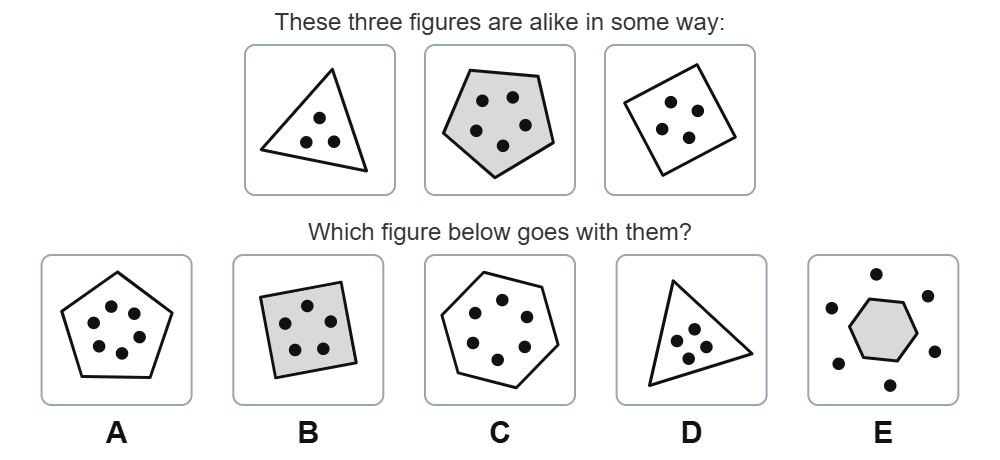
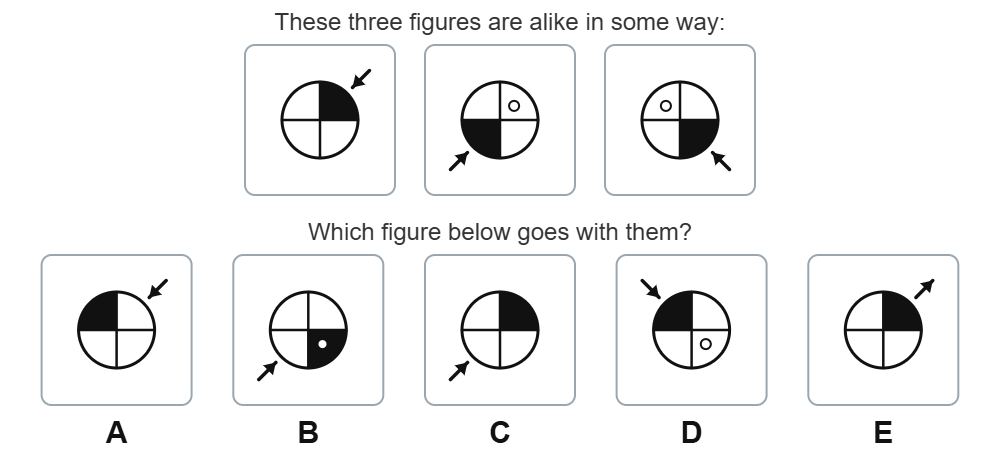
5. Figure classification
The three figures at the top share a rule, but the shapes, sizes and shading that change are only there to distract you. Which figure below follows the same rule?
Question 1
Question 2
Show answers
- C: the number of dots inside equals the number of sides
- D: the arrow points at the one shaded quarter
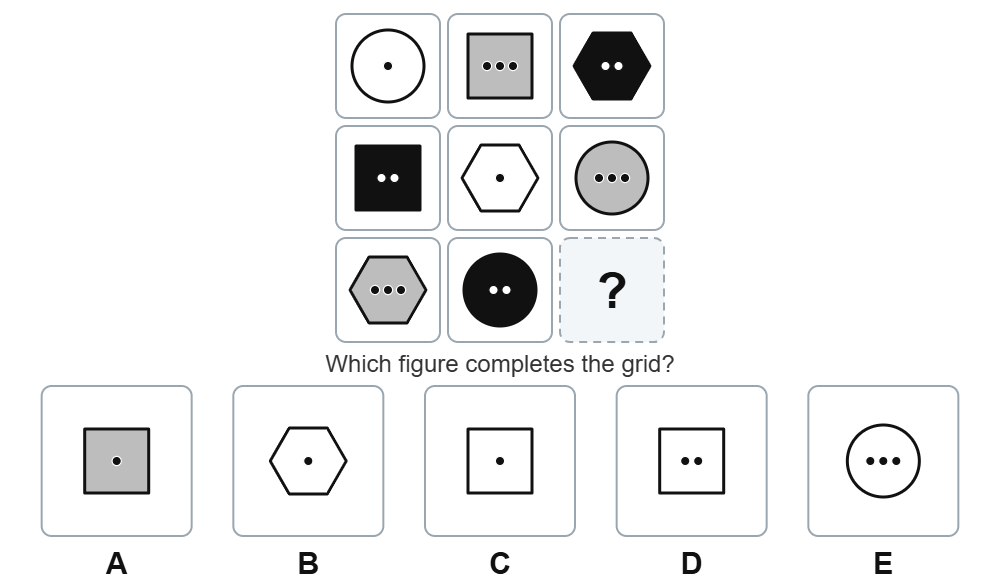
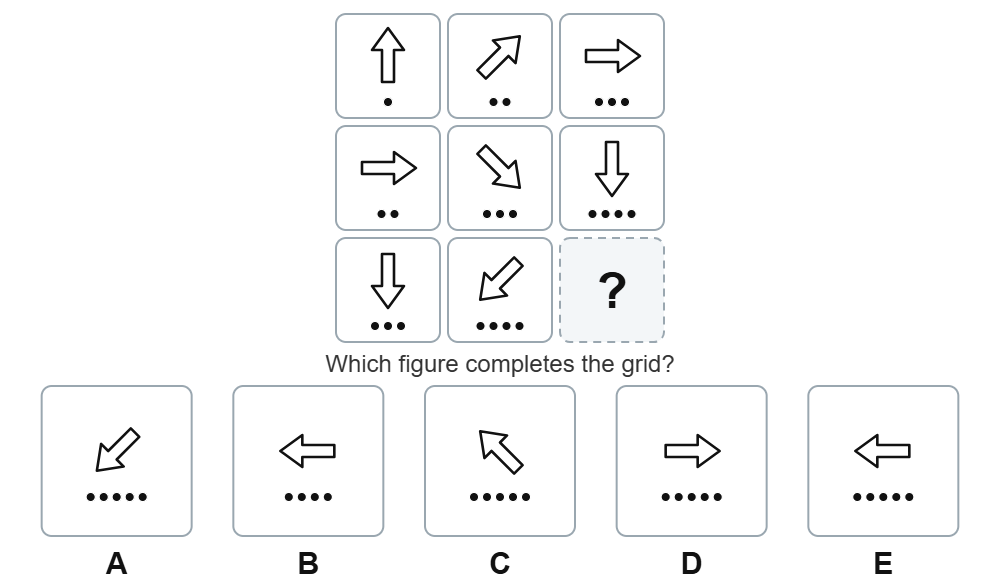
6. Figure matrices
Work out the rules across each row and down each column, then find the figure that completes the grid.
Question 1
Question 2
Show answers
- C: every row and column has one circle, one square and one hexagon; one, two and three dots; and one white, one grey and one black shape
- E: the arrow turns 45° clockwise along each row and 90° clockwise down each column, and there is one more dot along each row and down each column
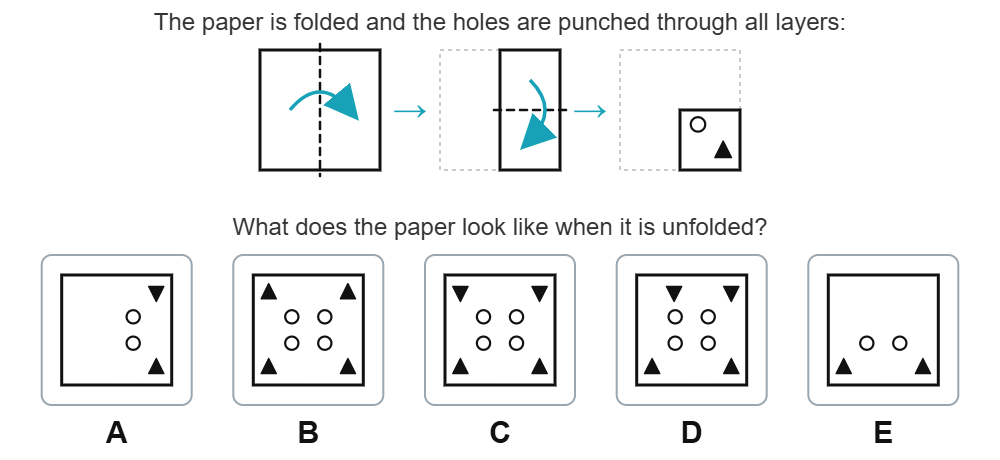
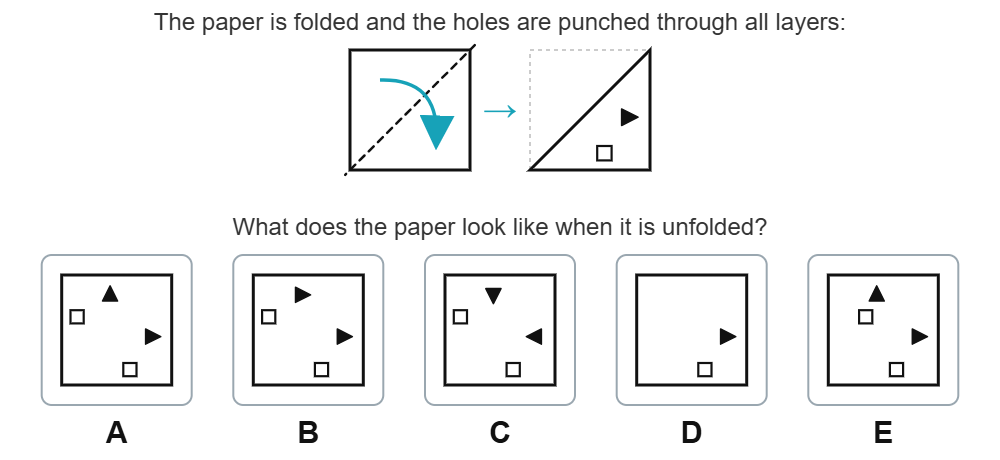
7. Figure analysis (paper folding)
A square of paper is folded along the dashed line(s) and holes are punched through all the layers. What does it look like unfolded? Watch which way the triangles point.
Question 1
Question 2
Show answers
- C: two folds make four layers, and each triangle flips when it is mirrored across a fold
- A: each hole is mirrored across the diagonal, so the triangle now points up
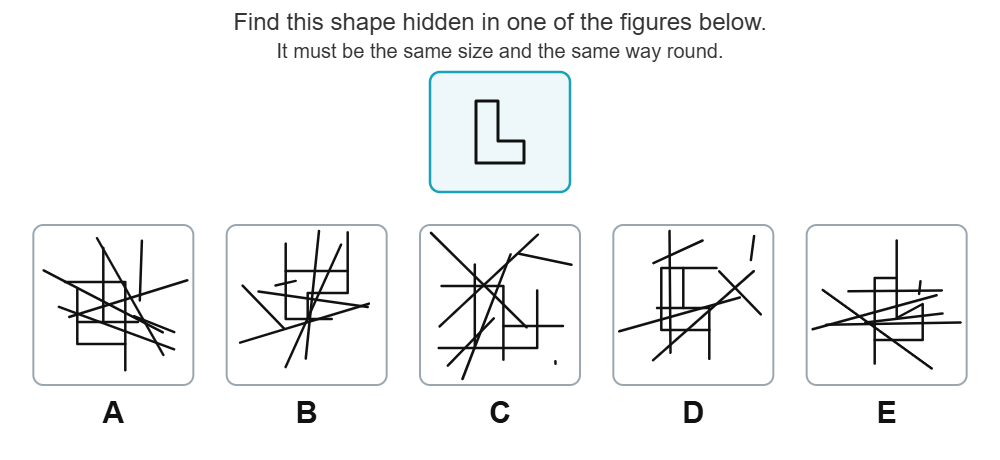
8. Figure recognition (hidden shapes)
Find the shape in the blue box hidden in one of the five figures. It must be exactly the same size and the same way round, not turned or flipped.
Question 1
Question 2
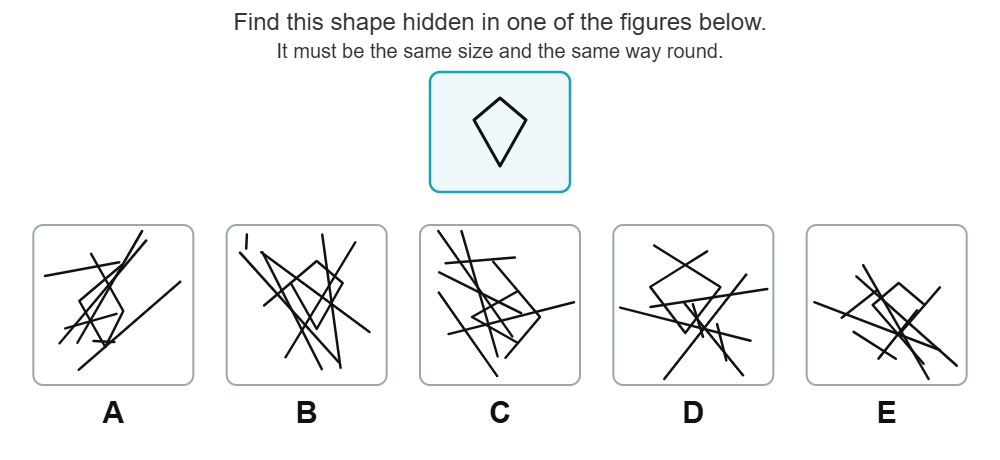
Show answers
- D. A is flipped, B is turned, C is wider and E has a different corner.
- B. The others are turned, stretched or have one corner moved.
Ready for more? The free booklet has 24 more questions like these, ready to print.
How to read your child’s Year 7 CAT4 report
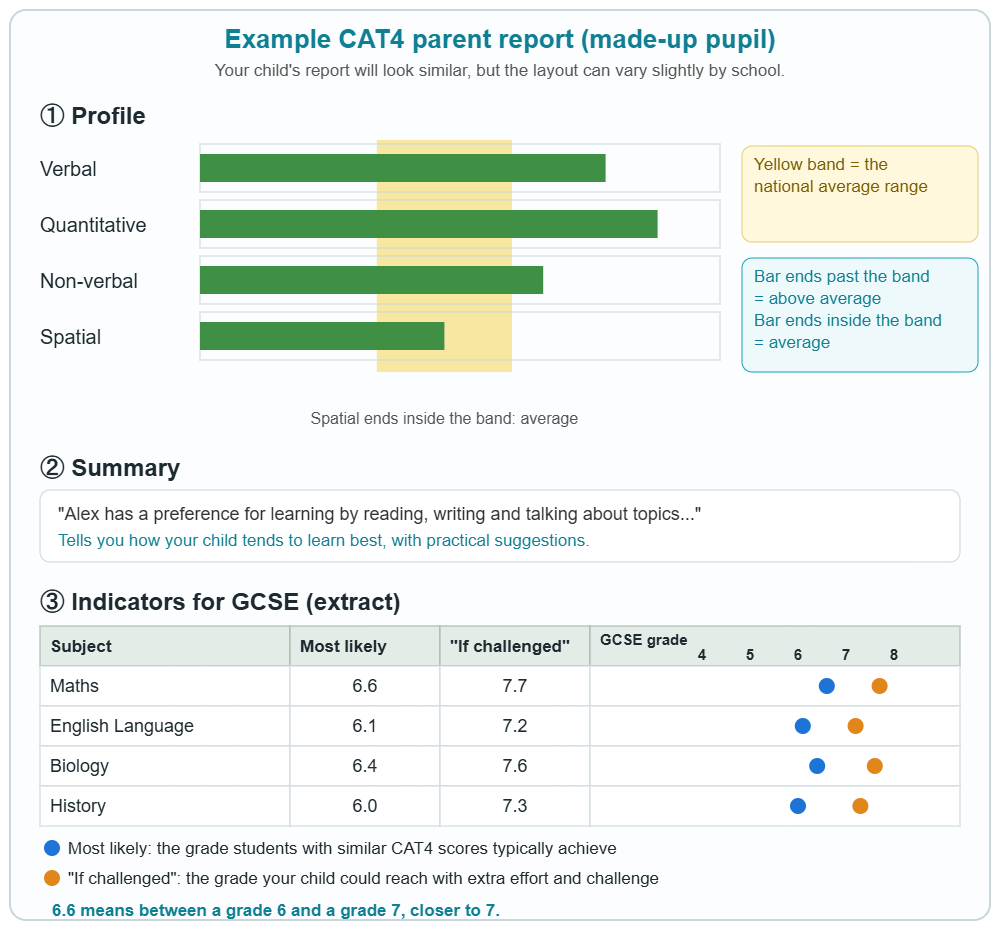
Most parents receive a short report with three parts: a profile chart, a summary, and a table of indicators for GCSE. It usually does not show detailed scores; those appear in the version of the report that teachers see (more on that below).
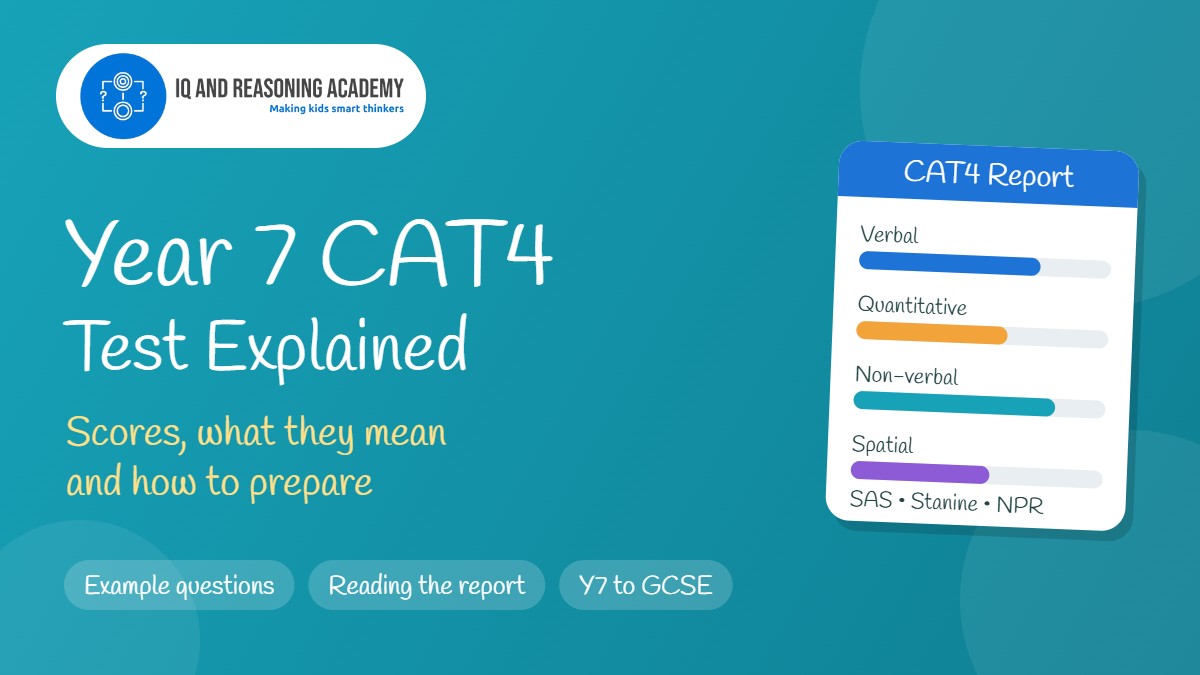
1. The profile chart
There is one bar for each part of the test: verbal, quantitative, non-verbal and spatial. The yellow shaded band shows the national average range:
- A bar that ends past the yellow band is above average.
- A bar that ends inside the band is in the average range.
- A bar that ends before the band is below average.
Look at the overall shape as well as each bar. A big difference between two bars tells you more than a small one, which can simply be down to how your child felt on the day.
2. The summary
This short paragraph describes how your child tends to learn best, based on the balance between their verbal and spatial results. For example, “a preference for learning by reading, writing and talking about topics” points to a verbal strength, while a spatial strength usually means learning well from diagrams, models and pictures. Some children have an even balance. None of these is better than another, and the practical suggestions in this part of the report (wider reading, clubs, extra challenge) are well worth following.
3. Indicators for GCSE
This is the part most parents focus on: a long table of subjects, each with two predicted grades:
- Most likely grade: the grade that students with similar CAT4 results typically achieve.
- “If challenged” grade: in GL Assessment’s words, the grade a student “could reach with additional effort and challenge”.
- The decimals show where a prediction sits between two grades. For example, 6.7 is between a grade 6 and a grade 7, closer to a 7. The coloured dots on the right show the same thing visually.
Keep these in perspective. They come from one test taken in the first weeks of Year 7, about five years before GCSEs. They are a starting point, not a limit: the “if challenged” grade is a sensible goal, and many children go on to beat both predictions. The table also lists subjects your child’s school may not offer, and some subjects carry asterisks; check the key at the bottom of the report for what these mean.
What about SAS, stanines and percentiles?
Behind the report, the school holds more detailed scores for each part of the test:
- SAS (Standard Age Score): adjusted for age in months. 100 is the national average, and roughly 89 to 111 counts as average.
- Stanine: a 1 to 9 scale, where 4 to 6 is average.
- National Percentile Rank: the percentage of children nationally your child scored above.
These are not usually included in the parent report. If you would like them, for example to see exactly how far above or below average each bar is, it is perfectly reasonable to ask your child’s form tutor or head of year.
What do schools do with Year 7 CAT4 scores?
- Setting: many schools use CAT4 alongside other evidence to place pupils in sets for maths, English and science. Sets are usually reviewed during the year, so an early placement is not final.
- GCSE target grades: many schools use the same GCSE indicators you see on the report, alongside teachers’ own assessments, to set targets. These are a starting point, not a ceiling. Many children go on to beat them.
- Spotting hidden potential: if a child’s CAT4 scores are much higher than their classwork, teachers can look into why, for example gaps from primary school or low confidence.
CAT4 has no pass mark, and in Year 7 it is not used to decide whether your child keeps their place. If you are unsure how your school uses it, it is perfectly reasonable to ask your child’s tutor or head of year.
How to prepare for the Year 7 CAT4 test
GL Assessment does not recommend intensive coaching, and drilling hundreds of questions can actually make the results less useful, because the school then sets targets from an inflated score. However, sensible familiarisation helps children show what they can really do:
- Get to know the eight question types so nothing looks unfamiliar on the day. A couple of short timed practice tests are plenty. Pretest Plus CAT4-style practice tests are one option, and they help children get used to the tight timing.
- Read widely. Vocabulary and word relationships drive the verbal battery more than anything else.
- Play with shapes. Jigsaws, tangrams, Lego, origami and puzzle apps all build spatial thinking without feeling like revision.
- Practise mental maths and number patterns, such as times tables and simple sequences, for the quantitative battery.
- Keep it calm. A good night’s sleep and a normal breakfast matter more than last-minute practice.
If the results were disappointing
First, don’t panic. A single test on one morning in a new school, often in the first weeks of term, is not the full picture. Nerves, tiredness and unfamiliar computers all affect scores. Instead, look at which battery was lowest:
- Low verbal: build reading and vocabulary every day. Our vocabulary guide has ideas that work at any age.
- Low quantitative: strengthen number fluency and the Year 6 to Year 7 maths jump: fractions, negative numbers and early algebra.
- Low non-verbal or spatial: puzzles, drawing and building activities make a real difference over a few months.
Children who did well in 11+ reasoning, including the ISEB Pre-Test and CEM Select, will recognise many of these question types. Those skills keep paying off throughout secondary school.
Final thoughts
The Year 7 CAT4 test is best seen as a snapshot of how your child thinks, not a judgement on how clever they are or what they will achieve. Used well, it helps teachers support your child in the right way from the start of secondary school.
At IQ and Reasoning Academy, we now support students from Year 7 through to GCSE, building strong reasoning, maths and English foundations early. If you’d like help understanding your child’s CAT4 report or planning next steps, message us on WhatsApp at +91 70214 36408.