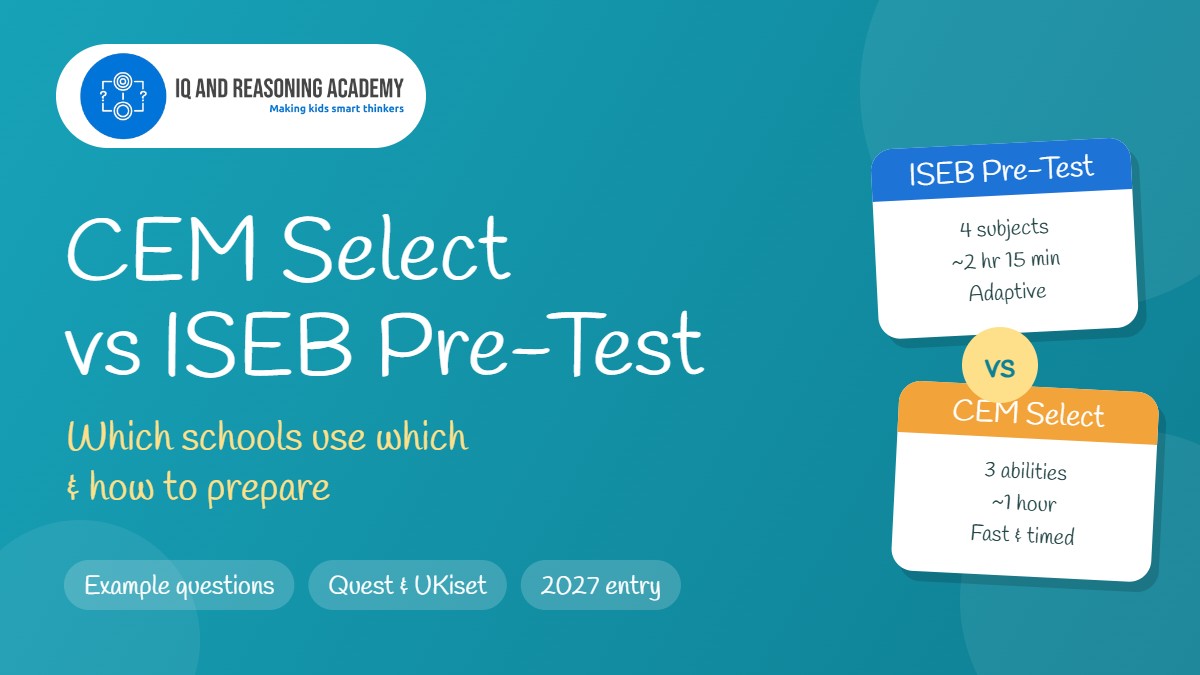
Independent school entrance season is here, and many Year 6 families are now comparing CEM Select vs ISEB Pre-Test, two very different online entrance tests. Both are taken on a computer, and both cover reasoning and maths. Beyond that, they work quite differently, and preparing for one in the same way as the other can catch children out.
In this guide we explain how the two tests differ, which schools use which, what the questions look like, and how to prepare for each. We also cover two other formats you are likely to meet: Quest and UKiset.
Disclosure: some links in this article are affiliate links. If you buy through them, IQ and Reasoning Academy may earn a small commission at no extra cost to you. We only recommend resources we think are useful for our students.
First, a quick note on names
CEM Select is now officially called Cambridge Select Insight. It was renamed in early 2025 and is run by Cambridge University Press & Assessment. Most parents, tutors and schools still call it “CEM Select”, so we use both names here. However, it is a different test from the old CEM 11+ that grammar schools used until 2022, which Cambridge has since withdrawn. If you are comparing it with grammar school papers, see our earlier post on GL style vs CEM Select.
CEM Select vs ISEB Pre-Test at a glance
| ISEB Common Pre-Test | CEM Select (Cambridge Select Insight) | |
|---|---|---|
| Run by | Independent Schools Examinations Board (ISEB) | Cambridge University Press & Assessment |
| Subjects | English, Maths, Verbal Reasoning, Non-Verbal Reasoning | Verbal, Numerical and Non-Verbal ability |
| Length | About 2 hours 15 minutes in total (English 40, Maths 40, NVR 30, VR 25) | About 1 hour, split into six short timed sections |
| Adaptive? | Yes. Questions get harder or easier depending on your child’s answers | No. Every child sees the same questions |
| Going back | Not allowed. Once answered, a question is locked | Allowed within each section |
| Question style | Multiple choice | Multiple choice, drag-and-drop and type-in answers |
| How often | Once per year, with one result shared with every ISEB school you apply to | Sat separately for each school that uses it |
| Usually sat | Year 6, mostly September to December (some 13+ schools test in Year 7) | Set by each school, usually Year 6 autumn or winter |
| Scores | Standardised age score (average 100) for each test; parents don’t usually see it | Age-standardised scores sent to the school within 72 hours |
The ISEB Common Pre-Test explained
Around 80 independent senior schools subscribe to the ISEB Pre-Test, making it the most widely used screening test of its kind. Your child usually sits it once, often at their current school during the school day, and ISEB then shares the same result with every subscribing school you have applied to. Since 2022, parents have registered their child directly through the ISEB Guardian Portal.
The most important thing to understand is that it is adaptive. After every answer, the computer chooses the next question based on how your child is doing. A strong answer leads to a harder question, and a mistake leads to an easier one. This has two practical effects:
- Children cannot go back and change an answer. Every question has to be answered before moving on, so careful first attempts matter more than in a paper test.
- Hard questions are a good sign. Children often come out saying “it was really hard”. That usually means they were doing well, so it helps to tell them this beforehand.
Which schools use the ISEB Pre-Test?
Schools reported to use it include Eton, Harrow, Charterhouse, Marlborough, Radley, Shrewsbury, Wellington College, Wycombe Abbey, Sevenoaks and Tonbridge. Many boarding schools use it at 11 for Year 9 (13+) entry as well as Year 7 entry. For most schools it is only a first sift, followed by the school’s own tests, interviews and the head teacher’s reference.
CEM Select (Cambridge Select Insight) explained
CEM Select is a shorter, faster test used by a smaller group of selective independent schools, around 20 to 25 of them. It aims to measure underlying ability rather than coached knowledge. It lasts about an hour, split into six sections, each with its own strict time limit.
In contrast to the ISEB, it is not adaptive. Children can move back and forth within a section, but the pace is quick. The biggest challenge is usually speed and breadth of vocabulary, not difficult maths.
Which schools use CEM Select?
Schools reported to use it for 11+ entry include St Paul’s Girls’ School, Guildford High School and Bancroft’s School. That said, schools do change providers, so always check the admissions page of each school on your list for the current year.
Example questions: CEM Select vs ISEB style
To give you a feel for each test, here are some short examples in a similar style. Try them with your child. The answers are at the end of this section.
ISEB-style examples
- Verbal reasoning (synonym): Which word is closest in meaning to RELUCTANT? (eager / hesitant / angry / careless / tired)
- Verbal reasoning (code): If CAT is written as DBU, how is DOG written?
- Maths: A notebook costs £4.75. How much do 6 notebooks cost?
- Non-verbal reasoning: In a sequence, a shape gains one extra side each time: triangle, square, pentagon … Which shape comes next, and how many sides will the shape after that have?
CEM Select-style examples
- Verbal (missing word): The scientist was completely ________ by the unexpected results. (baffled / bubbled / battled / bundled)
- Verbal (odd one out): Which word does not belong? (river, stream, brook, meadow, creek)
- Numerical: Mia has 3/5 of 45 marbles. She gives away one third of her marbles. How many does she have left?
- Numerical (data): A class of 30 voted for their favourite fruit. 40% chose apples. How many children chose something else?
Answers: hesitant · EPH · £28.50 · hexagon, then a 7-sided heptagon · baffled · meadow (the others are all flowing water) · 18 · 18
Beyond CEM Select vs ISEB: other formats you may meet
Quest
Quest assessments are online tests built specifically for each school, so the content varies. The London 11+ Consortium of 13 schools shares a single Quest test of about 100 minutes. It includes Maths, English, Verbal and Non-Verbal Reasoning, Problem Solving and Creative Comprehension, with no extended writing. Quest is also reported to be used by Haberdashers’ Boys’ and Girls’, Forest School and The Perse at 11+, and by schools such as Rugby, Uppingham and Sherborne at 13+. Furthermore, parts of it are adaptive. In the Consortium test, children cannot go back once a section is finished.
UKiset
UKiset is designed for overseas applicants to UK boarding and independent schools. It includes an adaptive reasoning test, an English test (reading and listening, reported as a CEFR level such as B2), and a short handwritten essay. One result can be sent to many schools, and it is widely accepted by boarding schools.
School’s own papers, GL and FSCE
Some schools, such as Highgate and North London Collegiate, still set their own English and Maths papers. State grammar schools mostly use GL Assessment or FSCE. You can read more in our posts on GL style tests and the FSCE format.
How to prepare for CEM Select and the ISEB Pre-Test
ISEB Pre-Test preparation tips
- Use the free ISEB Walkthrough. It lets your child try the real test screen beforehand, which takes away a lot of nerves.
- Build verbal and non-verbal reasoning. These aren’t taught at school, so they need regular short practice in Year 5 and early Year 6.
- Practise “answer once, then move on”. Since there is no going back, train your child to read every option before clicking.
- Practise on screen, not just on paper. Reading a passage on a computer feels different. Timed online practice tests make a real difference. ISEB’s own endorsed platform is Bond Online Premium Plus, and Pretest Plus ISEB-style practice tests offer full-length mocks in a similar format.
- Remember the result counts once. Your child only gets one attempt per year, so make sure they are well rested on the day.
How to prepare for CEM Select
- Work on speed. Six short timed sections reward quick, accurate thinking. Practise mental arithmetic and short timed sets of 10 questions.
- Grow vocabulary every day. Reading widely and learning a few new words daily is the best long-term preparation for the verbal sections.
- Get used to the answer types. Drag-and-drop and type-in answers can slow children down if they’ve only practised multiple choice. Pretest Plus Cambridge Select Insight-style tests are a useful way to practise these formats. Note that Cambridge does not officially endorse any commercial practice material, but schools send families free familiarisation materials.
- Teach “skip and return”. Because children can go back within a section, they should move past a hard question and come back to it if time allows.
Getting ready for Quest and UKiset
- For Quest, use the familiarisation materials each school provides, and practise problem-solving and comprehension questions. London Consortium-style practice is available for families applying to those schools.
- For UKiset, focus on English reading, listening and timed essay writing alongside reasoning. UKiset practice tests help overseas students get used to the format.
A simple timeline
- Year 4 and early Year 5: reading, vocabulary and solid maths foundations (see our Year 4 and Year 5 guides).
- Spring and summer of Year 5: introduce verbal and non-verbal reasoning, and find out which test each school on your list uses.
- Summer before Year 6: timed online practice in the right format for each test.
- Autumn of Year 6: the tests themselves. Keep practice light, and focus on confidence and rest.
Final thoughts
In short, when it comes to CEM Select vs ISEB, the ISEB Pre-Test rewards steady, careful accuracy across four subjects, while CEM Select rewards speed and a wide vocabulary in one fast hour. Neither can simply be “learned”. However, familiarity with the format and regular reasoning practice can make a real difference to how confident your child feels on the day.
At IQ and Reasoning Academy we prepare children for the ISEB Pre-Test, CEM Select and other 11+ and 13+ formats in small online groups, with a strong focus on verbal and non-verbal reasoning. If you’d like help, message us on WhatsApp at +91 70214 36408 and we’ll suggest the right plan for your child’s schools.
School test providers can change from year to year. Always check the admissions page of each school before you plan your preparation.