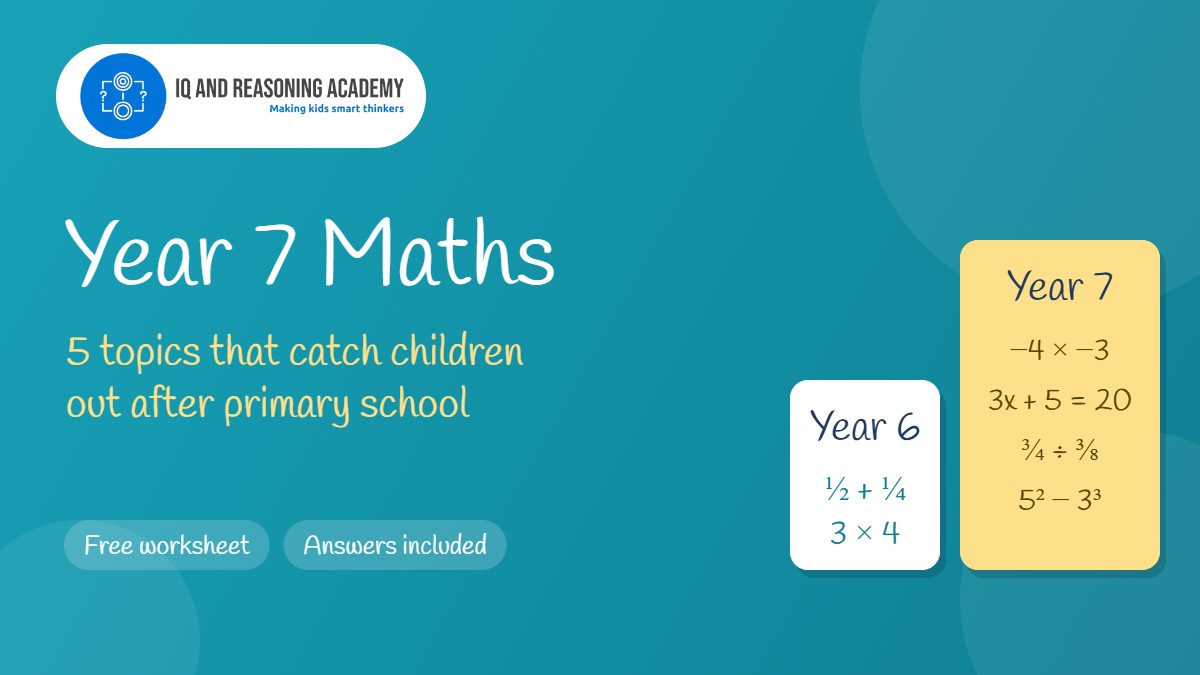
Many children who felt confident in Year 6 find Year 7 maths surprisingly hard. Usually, it isn’t that they have got worse at maths. Instead, familiar topics suddenly go a step further, and secondary school teachers expect more working and explanation.
This guide covers the five topics that change most from primary to secondary school, with Year 7-level example questions, the most common mistakes, and simple ways to help at home. There is also a free printable worksheet with 30 practice questions and answers.
The 5 Year 7 maths topics that catch children out
1. Negative numbers
What changes: In Year 6, children mostly use negative numbers in context, such as temperatures, and count across zero. In Year 7, they add, subtract, multiply and divide them.
Common mistake: Using “two negatives make a positive” for adding. For example, writing −7 + (−5) = 12 instead of −12. The rule only works for multiplying and dividing.
Try these:
- −4 × −3
- −7 + (−5)
- 3 − (−8)
Show answers
- 12
- −12
- 11
Tip for home: Use a number line for adding and subtracting, and practise the sign rules for multiplying separately.
2. Fractions
What changes: In Year 6, children multiply simple pairs of fractions and divide a fraction by a whole number. In Year 7, they use all four operations with any fractions, including mixed numbers and dividing one fraction by another.
Common mistake: Adding the tops and the bottoms: 3/4 + 2/3 = 5/7. The fractions need a common denominator first.
Try these:
- 3/4 + 2/3
- 3/4 ÷ 3/8
- 1 1/3 × 2 1/4
Show answers
- 17/12, or 1 5/12
- 2
- 3
Tip for home: Make sure times tables are completely secure. Almost every fraction mistake in Year 7 is really a times-table or common-denominator slip.
3. Algebra
What changes: In Year 6, algebra means simple formulae and “missing number” problems. In Year 7, children simplify expressions, expand brackets and solve equations step by step.
Common mistake: Multiplying only the first term in a bracket: 4(2x − 3) = 8x − 3 instead of 8x − 12.
Try these:
- Simplify 3a + 5b − a + 2b
- Expand 4(2x − 3)
- Solve 3x + 5 = 20
Show answers
- 2a + 7b
- 8x − 12
- x = 5
Tip for home: Ask your child to check equation answers by substituting them back in: 3 × 5 + 5 = 20.
4. Percentages and ratio
What changes: In Year 6, children find percentages of amounts and solve simple sharing problems. In Year 7, they work out percentage increases and decreases, share amounts in a ratio, and solve proportion problems.
Common mistake: Working out a percentage increase using the new amount. For a rise from £40 to £50, the increase is 10 ÷ 40 = 25%, not 10 ÷ 50 = 20%.
Try these:
- Increase £60 by 15%
- Share £56 in the ratio 3 : 5
- A price rises from £40 to £50. What is the percentage increase?
Show answers
- £69
- £21 and £35
- 25%
Tip for home: Use real shopping: sale prices, recipes for more people, and splitting bills are perfect everyday practice.
5. Powers, roots and order of operations
What changes: Children already use the order of operations with the four operations in Year 6. In Year 7, powers and roots join in, with longer calculations that need BIDMAS (Brackets, Indices, Division and Multiplication, Addition and Subtraction).
Common mistake: Working left to right: 3 + 4 × 2 = 14 instead of 11.
Try these:
- 5² − 3³
- √81 + √16
- 20 − 18 ÷ (2 + 1)²
Show answers
- −2
- 13
- 18
Tip for home: Learn the square numbers up to 15² and the first five cube numbers by heart. They come up constantly.
Why does Year 7 maths feel harder?
Apart from the new content, two things change:
- Showing working: secondary teachers expect a clear method, not just an answer. Marks in tests and later at GCSE depend on it.
- Explaining reasoning: questions increasingly ask children to explain, prove or show that something is true.
If your child’s Year 7 CAT4 quantitative score was lower than expected, these five topics are a good place to focus.
How to help with Year 7 maths at home
- Little and often: 15 minutes a few times a week works better than one long session.
- Ask “how did you work that out?” Explaining a method out loud builds the reasoning secondary maths needs.
- Use the school’s homework platform: many schools use online maths platforms with videos for each topic.
- Keep times tables sharp: they underpin fractions, algebra and ratio.
All of the questions above, plus 15 more, are in our free printable worksheet, with space for working and answers at the back:
Final thoughts
Year 7 is the start of the journey to GCSE, and the topics in this article are the foundations for almost everything that follows. Spotting gaps early and fixing them now is far easier than catching up in Year 10.
At IQ and Reasoning Academy, our year-long Year 7 Maths programme covers the syllabus topic by topic, with one dedicated teacher, building strong foundations for GCSE. To find out more, message us on WhatsApp at +91 70214 36408.