Comprehension is a key part of most 11+ entrance exams, testing a child’s ability to read carefully, understand ideas, and express answers clearly. Many students find comprehension challenging, especially when passages are long or questions require detailed written answers. However, with the right strategies, children can approach comprehension with confidence and accuracy.
Here are some of the most effective techniques to help children master comprehension for the 11+ exams.
1. Read the Questions First
One helpful strategy is to quickly read the questions before reading the passage.
This helps the child:
- Know what information to look for
- Focus on important details while reading
- Save time during the exam
For example, if a question asks “Why was the character nervous?”, the student will naturally look for clues about the character’s emotions while reading.
2. Read the Comprehension Passage Carefully (Twice if Needed)
Encourage students to read the passage slowly and carefully the first time. They should aim to understand the main idea, setting, and characters.
If the passage is difficult, reading it a second time can help them notice details they may have missed.
Tips:
- Pause briefly at punctuation.
- Pay attention to descriptive words.
- Try to picture the scene in their mind.
3. Highlight or Underline Key Information
When practising at home, children should underline important words or phrases in the passage.
These may include:
- Names of characters
- Important actions or events
- Words that show feelings
- Descriptions of places
This makes it easier to find answers quickly when responding to questions.
4. Understand the Type of Question
11+ comprehension questions usually fall into a few common categories:
Retrieval Questions
The answer is directly in the text.
Inference Questions
Students must read between the lines and use clues from the passage.
Vocabulary Questions
They must explain the meaning of a word using context.
Explanation Questions
Students may need to explain why something happened or how a character felt.
Teaching children to recognise the question type helps them decide how to answer.
5. Use Evidence from the Text
Many students lose marks because they answer using their own opinions instead of information from the passage.
Encourage them to:
- Refer directly to the text
- Use words or phrases from the passage as evidence
For example:
❌ He was scared because he was alone.
✔ He was scared because the passage says the forest was “dark and silent,” which made him nervous.
6. Write Clear and Complete Answers
For longer answers, students should learn to write full sentences that clearly explain their thinking.
A useful approach is:
Point → Evidence → Explanation
Example:
- Point: The boy felt worried.
- Evidence: The passage says his hands were shaking.
- Explanation: This shows he was nervous about what might happen.
7. Build Vocabulary Regularly
A strong vocabulary makes comprehension much easier.
Children can improve vocabulary by:
- Reading storybooks daily
- Learning a few new words each week
- Playing word games or quizzes
Understanding more words allows them to interpret passages more quickly.
8. Practise with a Variety of Passages
The best preparation is regular practice with different types of texts, such as:
- Fiction stories
- Informational passages
- Historical texts
- Descriptive writing
Exposure to different styles helps students become more flexible readers. Here is a great resource to practice.
9. Manage Time During the Exam
Many children spend too long reading or writing answers.
A good strategy is:
- Read passage: 3–4 minutes
- Answer questions: 10–12 minutes
- Review answers: 1–2 minutes
Time awareness prevents rushing at the end.
10. Encourage Reading for Enjoyment
One of the simplest ways to improve comprehension is regular reading for pleasure.
When children read books they enjoy, they naturally develop:
- better understanding of stories
- stronger vocabulary
- improved concentration
These skills directly support success in comprehension exams.
You can find our year wise recommended reading list here.
The 6 Comprehension MCQ traps most children fall into
in GL-style comprehension MCQs (like the ones used in the first round of The Henrietta Barnett School exams), many students lose marks not because they don’t understand the passage, but because they fall into very predictable traps built into the options.
Here are the six most common traps examiners use.
1. The “Almost Correct” Answer
This is the most common trap.
One option looks correct but changes one small detail from the passage.
Example:
Text:
The boy walked slowly through the foggy forest.
Options:
A. The boy ran through the forest.
B. The boy walked slowly through the foggy forest.
C. The boy walked quickly through the forest.
D. The boy walked slowly through the dark forest.
Students often pick D because it sounds logical, but “dark” was never mentioned.
✔ The correct answer must match the text exactly.
2. The “General Knowledge” Trap
Children sometimes choose answers based on what they know about the world, not what the passage says.
Example:
Question: Why did the girl carry an umbrella?
The passage says:
She carried the umbrella to shield herself from the strong sun.
But options include:
- Because it was raining.
Many students pick the rain answer because umbrellas are usually for rain.
✔ In comprehension, only the passage matters.
3. The Extreme Words Trap
Options often include strong words that make the answer incorrect.
Watch for words like:
- always
- never
- completely
- everyone
Example:
The passage suggests the character was slightly nervous, but an option says:
He was completely terrified.
Children pick it because it sounds dramatic.
✔ If the passage is mild, extreme answers are usually wrong.
4. The “Half-Right” Option
This option contains one correct idea and one wrong idea.
Example:
Option:
The dog barked loudly and chased the thief down the street.
But the passage only says:
The dog barked loudly.
Because the first part is correct, students often miss the incorrect second part.
✔ If any part is wrong, the whole option is wrong.
5. The Vocabulary Misleading Option
Vocabulary questions often include words with similar meanings but different contexts.
Example:
Word in passage: reluctant
Options:
- excited
- unwilling
- curious
- brave
Some children choose curious because it sounds intelligent.
✔ But reluctant = unwilling.
Students should learn to check the sentence meaning, not guess from familiar words.
6. The “First Sentence” Trap
Some students answer questions based on the beginning of the passage only.
But GL often places the answer:
- in the middle
- in the last paragraph
- spread across two sentences
Children who rush often miss these.
✔ The best strategy is to locate the part of the passage that matches the question before choosing.
The Golden Rule for GL Comprehension
Children must remember this simple rule:
“The answer must be proved from the passage.”
If they cannot point to the exact line that supports their answer, it is probably wrong.
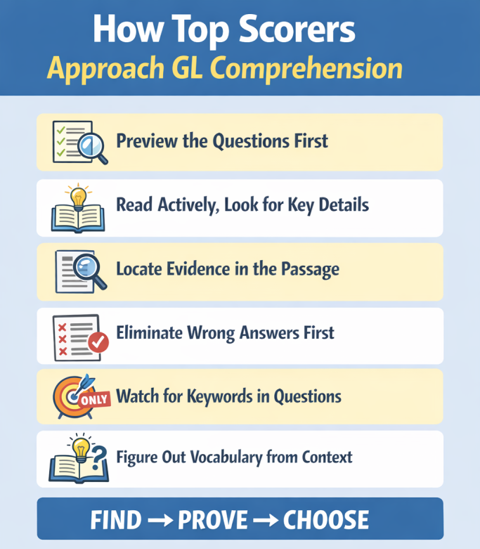
How Top Scorers approach GL Comprehension
Final Thoughts
While many 11+ preparation materials focus heavily on multiple-choice comprehension, few competitive schools require long-answer written responses. Practising these skills helps children develop deeper understanding, stronger vocabulary, and the ability to explain ideas clearly.
With regular practice and the right approach, students can become confident in tackling any comprehension format they encounter in the 11+ exams. If you are looking for assisstance in training your kids for comprehension, you can check out our English classes.