Verbal reasoning is part of the GL Assessment 11+ in most grammar school areas, and it is the paper that surprises parents most. It isn’t a spelling test or a reading test. It checks how well your child can spot patterns in words, letters and numbers, and how wide their vocabulary is.
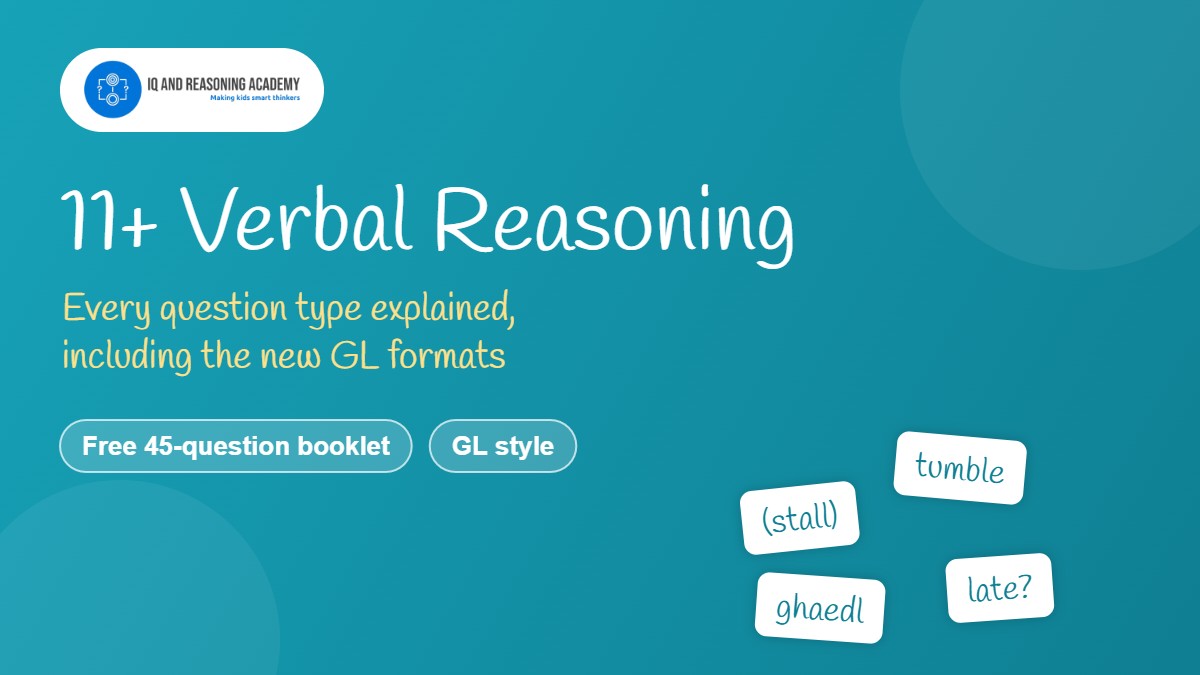
In this guide we go through every 11+ verbal reasoning question type in the GL style, with an exam-level example and answer for each. We also cover the newer formats that have started to appear, such as rhyming synonyms, related words in a grid and anagrams in a sentence.
Disclosure: this article contains affiliate links. If you buy through them, we may earn a small commission at no extra cost to you.
Which 11+ tests include verbal reasoning?
- GL Assessment: used by most grammar school areas, including Kent, Buckinghamshire, Lincolnshire and many single-school tests. Verbal reasoning is usually a separate paper, often in multiple-choice format.
- ISEB Common Pre-Test: used by many independent schools. It has a verbal reasoning section alongside English, maths and non-verbal reasoning.
- CEM Select: includes verbal reasoning questions that lean heavily on vocabulary, such as synonyms and antonyms.
The FSCE format, used by a growing number of schools, focuses on English and maths. You can read more in our article on the rise of the FSCE entrance exam format.
The 26 GL verbal reasoning question types
GL questions fall into four families. Knowing the family helps your child pick the right strategy quickly. Each example below is written at exam level. Tap Show answers to check.
Family 1: Making words
1. Missing letters
Find one letter that ends the first word and starts the second, in both pairs.
bea ( ? ) ead sta ( ? ) ope
Show answers
- r: bear, read, star, rope.
2. Move a letter
Move one letter from the first word to the second to make two new words.
stone ear
Show answers
- s: tone and sear.
3. Hidden words
A four-letter word is hidden across the end of one word and the start of the next. Find it.
We caught the cab leaving town.
Show answers
- able: cab leaving.
4. Missing three letters
Three letters next to each other have been removed from the word in capitals. They spell a word. Find it.
Our PNTS came to the school play.
Show answers
- ARE: PARENTS.
5. Use a rule to make a word
Work out how the middle word is made from the outer words, then use the same rule.
stop (open) envy clap (apex) exit into ( ? ) adds
Show answers
- toad: the 3rd and 4th letters of the first word, then the 1st and 2nd letters of the last word.
6. Compound words
Choose one word from each group to make a new word. The word from the first group comes first.
(sun, fire, hand) (fall, fly, pad)
Show answers
- firefly.
7. Word pairs and letter patterns
Work out the pattern in the first two pairs and complete the third.
pear → reap rats → star tram → ?
Show answers
- mart: each word is written backwards.
8. Anagrams in a sentence (new format)
The same letter has been removed from two jumbled words. Find the letter, then unjumble the words.
The children ghaedl because the clown was so yfnn.
Show answers
- u: laughed and funny.
9. Shuffled sentences
Rearrange the words to make a sentence. One word does not belong. Find it.
garden in children yellow the played the
Show answers
- yellow: “The children played in the garden.”
Family 2: Word meanings
10. Closest meaning
Choose one word from each group that is closest in meaning.
(rapid, slow, steady) (late, quick, calm)
Show answers
- rapid, quick.
11. Opposite meaning
Choose one word from each group that is most opposite in meaning.
(cautious, quiet, kind) (gentle, reckless, careful)
Show answers
- cautious, reckless.
12. Multiple meanings
Choose the word that goes equally well with both pairs.
(river edge, shore) (save, deposit) Options: coast, bank, store, safe, beach
Show answers
- bank: a river bank, and a place to save money.
13. Odd ones out
Two words do not belong with the other three. Find them.
apple carrot banana potato grape
Show answers
- carrot, potato: the others are fruits.
14. Word connections (analogies)
Choose the two words, one from each group, that complete the sentence best.
Bird is to (nest, fly, feather) as bee is to (honey, hive, sting).
Show answers
- nest, hive: where each one lives.
15. Rhyming synonyms (new format)
The word in brackets rhymes with a synonym of the missing word, but not with the missing word itself. Every option could fit the sentence, so you have to test the synonyms.
(stall) Be careful not to _____ off the ladder. Options: climb, tumble, step, jump, wobble
Show answers
- tumble: tumble means fall, which rhymes with stall.
16. Related words in a grid (new format)
The words in a grid are linked by the same rule. The link could be opposites, synonyms, idioms, compound words or a letter pattern. Find the missing word.
Top row: hot, up, early. Bottom row: cold, down, ?
Show answers
- late: each column is a pair of opposites.
Family 3: Maths and sequences
17. Number equations
Find the number that completes the sum.
7 × 6 − 12 = 15 × ?
Show answers
- 2: 42 − 12 = 30, and 15 × 2 = 30.
18. Letter sequences
Find the next pair of letters. Use the alphabet to help.
CX EV GT IR ?
Show answers
- KP: the first letter moves forward 2, the second moves back 2.
19. Number sequences
Find the next number in the series.
2 3 5 9 17 ?
Show answers
- 33: the gap doubles each time (1, 2, 4, 8, 16).
20. Number connections
The numbers in each group are linked in the same way. Find the missing number.
(6 [30] 5) (8 [32] 4) (7 [ ? ] 9)
Show answers
- 63: the outer numbers are multiplied.
21. Letters for numbers
Letters stand for numbers. Work out the sum and give the answer as a letter.
A = 1, B = 2, C = 3, D = 4, E = 6. C × B = ?
Show answers
- E: 3 × 2 = 6.
Family 4: Logic and coding
22. Letter pair analogies
Find the letters that complete the sentence in the best way.
BD is to EG as MO is to ?
Show answers
- PR: each letter moves forward 3.
23. Letter codes
Use the same code to answer the question.
If PLANT is written QMBOU, how is TREE written?
Show answers
- USFF: each letter moves forward 1.
24. Number codes
Use the code to work out the word.
If STAR is written as 1234, what does 4321 spell?
Show answers
- RATS.
25. Logic puzzles
Read the information and answer the question.
Amy, Ben and Cara each have one pet: a cat, a dog or a rabbit. Amy is allergic to cats. Cara’s pet has long ears and hops. Who has the cat?
Show answers
- Ben: Cara has the rabbit, so Amy has the dog and Ben has the cat.
26. Ordering and position puzzles
Read the information and answer the question.
Five children ran a race. Sam finished last. Priya was second. Jo finished just ahead of Leo. Maya beat Leo. In which place did Leo finish?
Show answers
- Fourth: the order is Maya, Priya, Jo, Leo, Sam.
The newer GL verbal reasoning question types
Recently, some GL-style papers have added question types that look familiar but need deeper thinking. These are the three we see children struggle with most.
- Rhyming synonyms: the bracket word never rhymes with the answer itself. Your child has to think of synonyms for every option and test each one for the rhyme. A wide vocabulary is essential.
- Related words in a grid: the link changes from question to question. It might be opposites, synonyms, idioms such as “red herring”, compound words, or a letter trick like reversing a word.
- Anagrams in a sentence: two jumbled words are each missing the same letter. The sentence gives the clue to the meaning, but your child has to test letters until both words work.
Because these formats are new, there is less practice material for them. So we wrote a free booklet with 45 original exam-level questions, 15 on each new type, with worked examples, strategies and full answers.
Extra practice papers we recommend
For more practice on the newer formats, Exam Papers Plus has targeted packs on rhyming synonyms, related words and anagrams. They are a good next step once your child is confident with the booklet.
How to prepare for 11+ verbal reasoning in Year 5
For a full plan across all subjects, see our Year 5 11+ preparation guide. For verbal reasoning in particular, these habits make the biggest difference.
- Build vocabulary every day. Most of the harder question types depend on knowing words and their synonyms. Our article on focusing on vocabulary for the 11+ has ideas you can start today.
- Learn the question families, not just the questions. When your child recognises the family, they know which strategy to use.
- Know the alphabet positions. Codes and letter sequences are much faster if your child knows that M is 13 and can count backwards confidently.
- Practise under time. GL papers give well under a minute per question. Start untimed, then aim for about 45 seconds.
- Review every mistake. Ask: was it the meaning, the rule or a careless slip? That tells you what to practise next.
Final thoughts
11+ verbal reasoning rewards children who read widely and think flexibly. The question types can look strange at first, but each one follows a clear pattern. With steady practice from Year 5, most children become quick and confident.
If you would like help preparing your child for the 11+, our small online groups cover verbal reasoning, non-verbal reasoning, English and maths. WhatsApp us on +91 70214 36408 to find out more.