
In recent years, several UK grammar schools have begun rethinking how they assess pupils for Year 7 entry. One of the most notable developments has been the adoption of the FSCE (Future Stories Community Enterprise) assessment framework.
Among the schools embracing this change, Reading School has drawn particular attention for introducing a bespoke FSCE-based entrance test. This shift reflects a broader move away from highly coachable, formula-driven exams towards assessments that aim to capture a child’s underlying ability, curiosity, and readiness for secondary education.
What Is the FSCE Format?
The aim is to assess how pupils apply what they know — not just how quickly they can recognise familiar question patterns.
The FSCE entrance exam is designed around Key Stage 2 curriculum content (typically up to the end of Year 5) and focuses on how pupils apply knowledge rather than how quickly they recognise familiar question patterns.
While the exact structure can vary slightly by school, the standard FSCE format generally includes three core components:
1️⃣ English Paper
This typically assesses:
- Reading comprehension (fiction and/or non-fiction)
- Vocabulary in context
- Inference and explanation skills
- Grammar and language awareness
Questions may include:
- Multiple-choice items
- Short written responses
- Longer comprehension answers requiring explanation
The emphasis is on understanding and reasoning — not just retrieving facts.
2️⃣ Mathematics Paper
This assesses:
- Arithmetic accuracy
- Problem-solving
- Multi-step reasoning
- Application of KS2 concepts
Rather than rapid-fire short sums, questions often involve:
- Word problems
- Logical reasoning within maths
- Explaining working
Clear method and structured thinking are important.
3️⃣ Creative / Extended Writing Task
A distinctive feature of FSCE-style exams is the inclusion of a creative or open-ended writing task.
Students may be asked to:
- Continue a story
- Respond to an image prompt
- Write descriptively or imaginatively
- Present an argument or viewpoint
Assessment focuses on:
- Structure and coherence
- Vocabulary range
- Creativity and originality
- Technical accuracy
11+ Exam Formats – Comparison Table
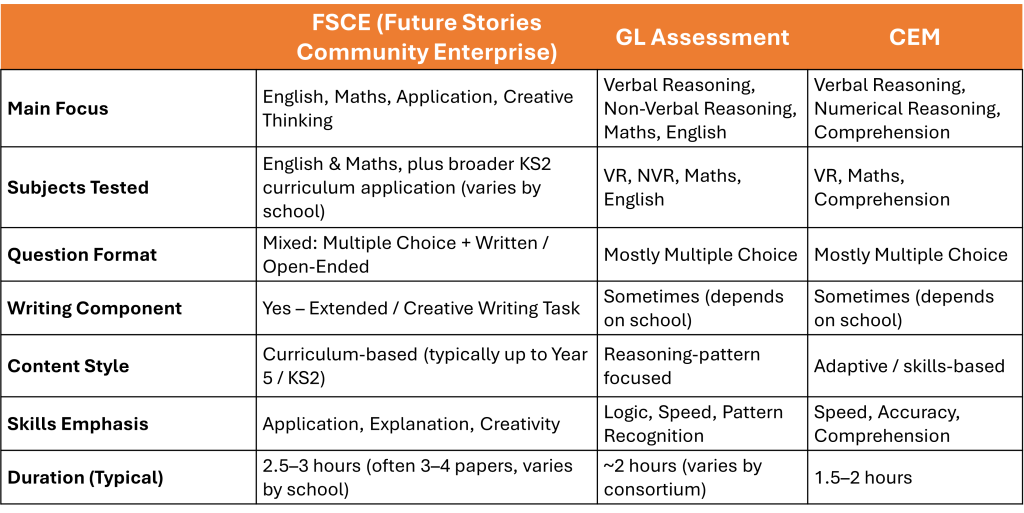
How Reading School’s FSCE Version Differs
Reading School uses an expanded four-paper structure instead of the standard three-paper model.
Their assessment includes:
- Adventure Paper (broad multiple-choice across subjects)
- Beacon Paper (short written responses)
- Compass Paper (multiple-choice reasoning-style tasks)
- Discovery Paper (creative/open-ended task)
This broader structure allows assessment across multiple curriculum areas, not just English and maths.
Other Grammar Schools Using FSCE
Reading School is not alone in adopting this format. Other selective grammar schools known to use the FSCE entrance assessment include:
- Chelmsford County High School for Girls
- Colyton Grammar School
- The Crossley Heath School
- Heckmondwike Grammar School
- The North Halifax Grammar School
- Skipton Girls’ High School
- Lancaster Girls’ Grammar School
While the structure may vary slightly between schools, the shared goal is to create a more curriculum-linked and skills-focused assessment.
Where Can Students Practise the FSCE Format?
As the FSCE format differs from traditional GL or CEM-style 11+ exams, many parents ask where children can find suitable practice material. While official past papers are not widely released publicly, there are several useful familiarisation and practice resources available.
📄 Free or Familiarisation-Style Resources
Exam Berry Papers – Crossley Heath Familiarisation Papers
Includes free English, maths, and creative writing practice materials aligned to FSCE-style assessments:
https://examberrypapers.co.uk/resources/free-11-plus-practice-papers/the-crossley-heath-school/
The Exam Coach – Sample 11+ Practice Paper
Free downloadable practice paper (sign-up required), with mixed question types similar to FSCE:
https://www.theexamcoach.tv/11-plus-practice-papers-and-answers/reading-school
📥 Paid Practice Test Packs (PDF Downloads)
Exam Paper Plus – School wise practice
High quaity, school specific FSCE-style English, maths and writing papers:
https://exampapersplus.co.uk/browse/papers/eleven-plus/11-plus-exam-reading-school-practice-test-1/#a_aid=ira
The Mandy Method – FSCE Practice Test Bundle (Pack 1–3)
Multiple downloadable FSCE-style tests with answers:
https://themandymethod.uk/product/fsce-11-practice-test-bundle-pdf-download-pack-1-pack-2-pack-3
🧠 Online Learning Platforms
Atom Learning – FSCE 11+ Practice & Mocks
Interactive practice and mock tests aligned with FSCE-style assessments:
https://www.atomlearning.com/blog/fsce-11-plus
Important Note for Parents
Official FSCE Ltd materials are typically distributed directly through participating schools rather than publicly published:
https://www.fsce.co.uk/
Therefore, the most reliable preparation approach combines:
- Structured reasoning and writing practice – we run creative writing focussed classes for Y4-Y5
- School-issued familiarisation materials
- Strong Key Stage 2 curriculum foundations
Why the Shift to FSCE — and What It Really Means
In recent years, some schools have changed their 11+ exam format because traditional tests were becoming too predictable and heavily coached. The intention behind these changes is clear: to move away from rote preparation and instead assess natural thinking ability, creativity, and problem-solving skills.
By introducing unfamiliar question types and broader tasks, schools hope to identify pupils who think independently — not just those who have practised standard question patterns extensively.
However, it is important to recognise that thinking skills are not fixed traits. Problem-solving, logical reasoning, and creativity can all develop with meaningful practice. When children regularly engage in reading, puzzles, discussions, open-ended questions, and challenging tasks, these abilities strengthen over time. When exam formats change, preparation does not disappear — it simply evolves.
Fairness is another important consideration. Not all families have equal access to tutoring or structured guidance. If the goal is truly to assess deeper thinking skills, schools can help level the playing field by providing free familiarisation materials, reasoning workshops, and curriculum-based skill support. Clear communication about what is being assessed can also reduce anxiety and uncertainty.
Ultimately, rather than focusing on whether an exam can be made “tutor-proof,” the conversation should centre on how we can help all children build strong thinking skills — skills that extend far beyond any entrance test and support long-term academic success.
Final Thoughts
The growing adoption of the FSCE format signals a meaningful shift in selective education. With Reading School leading through its expanded assessment structure, the emphasis is increasingly on reasoning, understanding, and intellectual curiosity.
For parents, the key message is this: strong foundations in reading, mathematics, discussion, and creative thinking matter more than repetitive drilling. And for schools, the challenge remains balancing rigour, fairness, and accessibility in a competitive admissions landscape.